
Beringia facts for kids

Beringia was a huge area of land and sea that existed a very long time ago. It stretched from what is now eastern Russia to Alaska and parts of Canada. Imagine a giant bridge made of land connecting two continents! This "land bridge" appeared and disappeared over thousands of years as global sea levels changed.
This amazing land bridge, sometimes called the Bering land bridge, was super important. It allowed plants, animals, and even early humans to travel between Asia and North America. Today, most of Beringia is underwater, forming the Bering Sea and Bering Strait. Only a few islands, like the Diomede Islands, the Pribilof Islands, St. Lawrence Island, St. Matthew Island, and King Island, are still visible from this ancient land.
Scientists believe that a small group of early humans, perhaps a few thousand, arrived in Beringia from eastern Siberia. They lived there during the peak of the last ice age. Later, they expanded into the Americas, sometime between 23,000 and 21,000 years ago. This happened after the American glaciers blocking their way melted, but before the land bridge was covered by the sea again about 11,000 years ago.
Contents
What Was Ancient Beringia Like?

Long, long ago, Earth experienced several "ice ages." During these times, huge sheets of ice, called glaciers, covered large parts of North America and Europe. So much water was frozen in these glaciers that the global sea level dropped significantly. When the sea level fell, the shallow seabed between Asia and North America became dry land. This is how the Bering land bridge appeared!
This land bridge could be as wide as 1,000 kilometers (about 620 miles). It was a vast, open landscape, covering an area as large as the Canadian provinces of British Columbia and Alberta combined. Scientists like Eric Hultén and David Hopkins helped us understand this ancient region. They studied plants and geology to piece together the story of Beringia. The Bering Strait, which is now about 40-50 meters (130-160 feet) deep, was once completely dry.

The land bridge wasn't always there. It appeared and disappeared several times over hundreds of thousands of years. For example, it was a land bridge from about 70,000 to 60,000 years ago, and again from about 30,000 to 11,000 years ago. After that, the ice melted, sea levels rose, and the land bridge was covered by water again.
Life in Ancient Beringia

During the last major ice age, which ended about 11,000 years ago, Beringia was a unique place. It wasn't covered in ice like many other parts of the world. Instead, it was a cold, dry grassland called the "mammoth steppe." This steppe stretched from the Arctic islands all the way to China, and across Eurasia into Alaska and the Yukon.
Beringia was a special "refugium," which means a safe place or a shelter for plants and animals. It received more moisture from the North Pacific Ocean than the very dry areas around it. This allowed different kinds of plants, like shrubs and grasses, to grow. These plants provided food for a rich community of large animals.
Animals of Beringia
Many incredible creatures roamed Beringia. Imagine seeing woolly mammoths, saiga antelopes, and ancient horses! These animals were well-adapted to the cold, grassy environment. Their fossils help scientists understand what life was like back then.

Interestingly, some animals were found only on one side of Beringia. For example, the Woolly rhinoceros lived in Siberia but didn't cross into North America. And animals like the American mastodon and American badger were found in North America but not in Siberia. This suggests there might have been some natural barriers even on the land bridge itself.
As the climate changed, so did Beringia's ecosystem. When it got warmer and wetter, forests started to grow. When it got colder and drier, grasslands expanded. These changes determined which animals and plants could survive and thrive. For instance, grey wolf populations had a big reduction in numbers about 25,000 years ago. Later, new groups spread out from Beringia to repopulate other areas.
Early Humans in Beringia

One of the most exciting parts of Beringia's story is its role in human history. Scientists believe that a small group of early humans traveled from Asia into Beringia during the last ice age. They lived there for thousands of years, adapting to the cold environment.
These early people were likely following the large animals they hunted, like mammoths. When the huge glaciers in North America began to melt, pathways opened up. This allowed these ancient Beringians to move southward and eventually settle all across the Americas. This journey happened sometime between 23,000 and 21,000 years ago.
Much later, about 3,000 years ago, the ancestors of today's Yupik peoples settled on both sides of the Bering Strait. Today, Russia and the United States are working together to protect this shared heritage. They want to create a special area to remember and study Beringia's history.
Ancient Connections Between Continents

Beringia wasn't the only time Asia and North America were connected. Long before the land bridge, there were other ways for plants and animals to move between these continents.
For example, scientists have found similar dinosaur fossils in both Asia and North America. This shows that dinosaurs like Saurolophus and relatives of Tyrannosaurus rex could travel between these landmasses many millions of years ago.
Even ancient wolves, like the earliest known Canis lupus, have fossils found in both Canada and Alaska, dating back almost a million years. This suggests that wolves also originated in this eastern Beringia region. Over millions of years, many different kinds of plants and animals have moved back and forth between Asia and North America, shaping the life we see on both continents today.
Images for kids
-
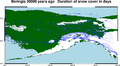
Duration of snow cover in days, East Beringia, 20000 years ago.
-
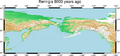
Beringia, 8000 years ago.


See also
 In Spanish: Puente de Beringia para niños
- Bering Strait crossing
- Bluefish Caves
- Little John (archeological site)
- Geologic time scale
- Paleoshoreline
- Yukon Beringia Interpretive Centre
